

For years, Finnish leadership (and business) culture has loved the idea of being rational, data-driven, future-oriented. We built an entire national identity around competence.
Quiet competence especially. Let's not make any unnecessary noise about it. No Silicon Valley performance, no small talk, no marketing theatrics. Just well engineered products, results.
On paper, we could be the leading European country in AI. Finland has a high level of education, deep engineering and data science talent, and a solid research ecosystem spanning universities, VTT, and startups. And then add a growing ecosystem of AI startups and scaleups in areas like industrial AI, health tech, logistics, and software tools, while many established companies are already adopting AI in everyday operations.
In practice, AI is already widely used across organizations for things like marketing optimization, customer service automation, forecasting and analytics, software development workflows, and general efficiency improvements.
So Finland actually has strong AI capability, but according to the new 2026 leadership team study by Lifted, Finnish executive teams are profoundly unprepared for the AI era.
Yes, we have the technical capabilities, critical AI thinkers, but the leadership is not equipped to lead us to AI dominance, and that should concern all of us.
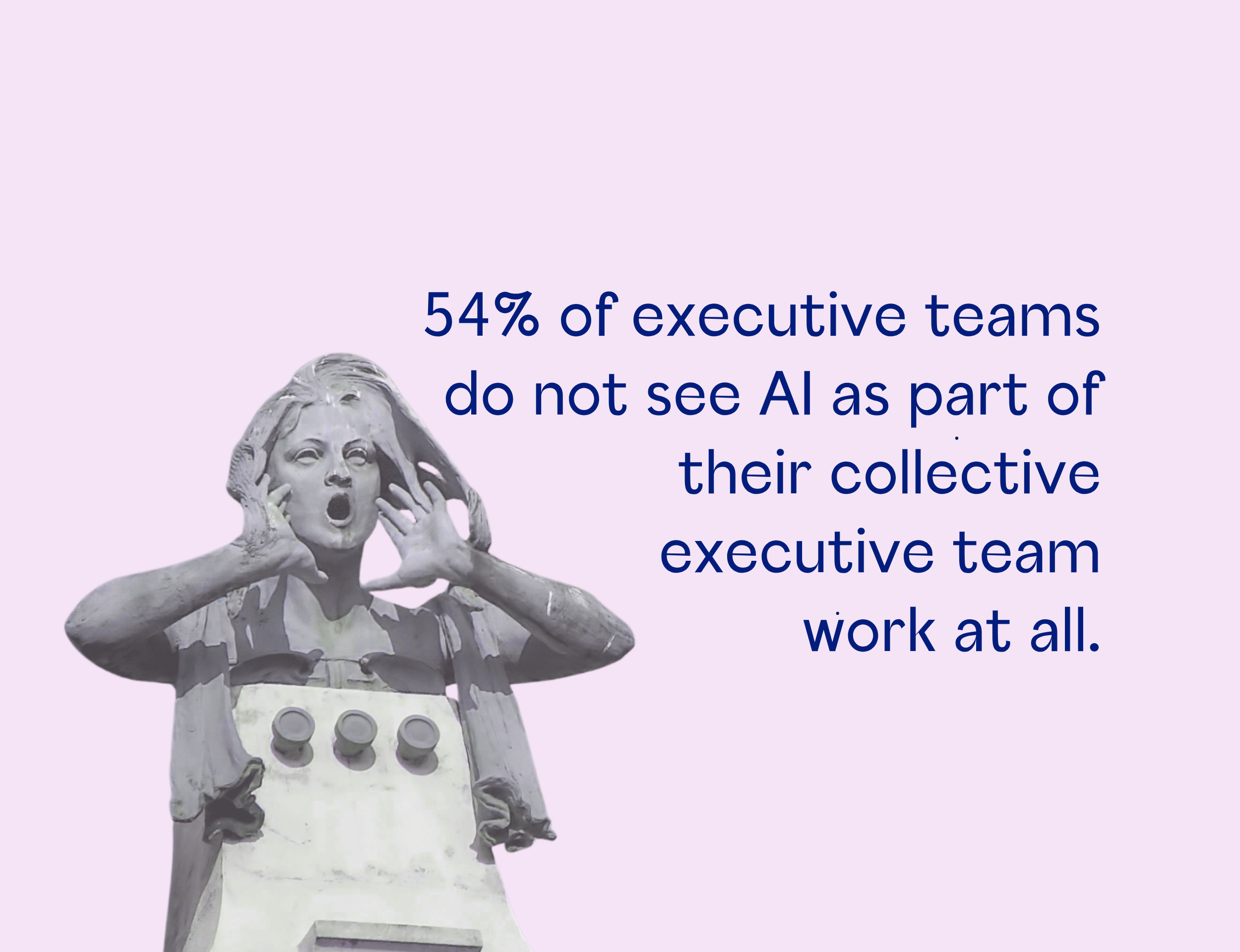
The study by Lifted is based on responses from nearly 300 executive team members and chairs across Finland. The study found that 54% do not see AI as part of their collective executive team work at all. AI exists somewhere in the organization, perhaps in isolated experiments, perhaps in productivity hacks, perhaps in a workshop someone attended once. But strategically? Structurally? As part of leadership thinking? Barely.
Even more striking: only around 30% felt their leadership teams properly recognize the organizational changes and opportunities AI creates.
Paradoxically, technology can not solve a leadership imagination problem.
Unsurprisingly, I think I know who can: women.
One of the study’s most revealing findings is that data is still primarily used to analyze the past instead of anticipating the future, making organizations act slow, and reactive, instead of innovating new.
We are drowning in information, but many leadership cultures still fundamentally operate in engineering logic: optimize, control, reduce uncertainty, report upwards. But AI has a potential to change the nature of decision-making itself.
Leadership teams can no longer function as static approval machines that gather quarterly to review historical data charts while the world changes in real time around them. Future can't be planned in the annual or quarterly plans based on past information only, without flexibility to adjust to world or market situation.
The organizations that survive the next decade will not necessarily be the ones with the most advanced AI tools. They will be the ones whose leadership teams are capable of adaptive thinking, fast interpretation, distributed intelligence and cultural flexibility.
In other words: the human decision-making becomes more important, not less. Ironically, this is where many Finnish leadership teams appear weakest.
The study found that leadership groups still struggle with:
Only 16% said they had collectively evaluated the strengths and weaknesses of their executive team. That is super low.
Imagine trying to navigate the largest technological transformation in decades without seriously assessing whether the people steering the ship can actually work together effectively.
One of the study’s most quietly explosive findings is that CEOs and executive team chairs consistently rated their own leadership teams more positively than other members did.
The gap appeared across every measured category suggesting something many employees already intuitively know: power distorts perception. The higher someone climbs in an organization, the easier it becomes to lose visibility into what is actually happening in the operative level. Especially in cultures where feedback is softened or avoided.
The study even points to a kind of leadership solidarity culture inside executive teams. Feedback between peers is limited. Constructive criticism toward CEOs is rare. Psychological safety remains fragile. Micromanaging starts often from the owners or boards, trickles down to CEOs and leadership teams, and when it reaches the operative level, the directives are to take action on completely wrong things.
This all creates a dangerous paradox: The people with the greatest responsibility for transformation may also receive the least honest information about their own effectiveness, and they are not humble enough to take information from the operational side.
And that matters enormously in the AI era, because AI rewards organizations capable of confronting uncomfortable reality quickly, instead of helping organizations optimized for preserving hierarchy and avoiding friction.
When executive teams function less like strategic units and more like collections of strong individuals protecting their own operational territories, AI can't fix it.
There is another way to read this study: it is a leadership opportunity for a new kind of rebel leadership.
Because if the traits most needed in the AI era are:
Then women are already far more prepared for this transition than traditional leadership culture has recognized.
For decades, women have often been expected to operate relationally inside systems built around hierarchy. Many have learned to read rooms quickly, navigate ambiguity, connect silos, anticipate reactions, manage emotional dynamics and build consensus without formal authority.
The study itself shows that the highest-performing executive teams have:
That should radically change how leadership potential is viewed. The AI era may rewards a completely different leadership archetype than the previous one. An adaptive systems leader, with relational intelligence.
And women who understand both technology and human behavior simultaneously will become some of the most valuable leaders.
You don't have to learn coding or to become an AI engineer.
But learn to understand:
The study makes it painfully clear that many leadership teams are still beginners here. The people who can translate between technology, business, culture and human behavior will become extremely influential, and you have an opportunity to become a leader
The study practically screams that trust, collaboration and adaptive leadership correlate with organizational success.
These capabilities are not “soft" or "nice to have".
They are operational.
Strategic.
Measurable.
Economically relevant.
The companies surviving the AI transition will likely be the ones capable of learning collectively fastest, and being able to lead that kind of culture is the key skill in leadership.
Many careers plateau because people become excellent functional specialists but never transition into systems thinkers.
This report repeatedly emphasizes that leadership teams fail when members only defend their own operational silos.
The future belongs to people who can connect:
Become more visible with your way to lead.
Many women already are a leaders.
They facilitate.
Align.
Translate.
Stabilize teams.
Manage uncertainty.
Drive cultural cohesion.
But often without claiming those contributions as leadership capability, or without the l
This is the time to start doing exactly that.
Because organizations are about to desperately need leaders who can make humans function during continuous disruption.
And the people who can articulate that capability clearly will rise faster.

Taneli Rantala describes Finnish executive teams as too rigid to respond fast enough to changes in the operating environment.
“The low position of AI on the agenda of management teams is an alarming finding, but it speaks to a much deeper problem. Management teams lack the ability to anticipate changes in the operating environment and react to them quickly enough. Management teams are simply too rigid – in order to succeed, Finnish management teams need to be more innovative,” says Taneli Rantala, CEO of Lifted.

That rigidity may be Finland’s real risk.
Not lack of intelligence.
Not lack of education.
Not lack of technology.
Rigidity.
Because the organizations that thrive in the AI era will be the most adaptive, who are capable of questioning themselves before the market forces them to.
The ones willing to admit that old leadership models built for predictability do not work particularly well in new era, when decisions have to be made much faster, because the market situations change faster.
And perhaps most importantly: those executive teams and companies will thrive that are capable of understanding that the future of leadership is not just technological transformation, but it is human transformation disguised as a technology story.
Find the full study report here.
![[headshot] image of customer (for a landscaping service)](https://cdn.prod.website-files.com/6874a52f3965fab31cf07b31/68933f31920b3bb932df17bf_d5bdbbb-5608-4dc-ac-afd03aa5a4b_Untitled_design_-_2.webp)
Founder of Crush Movement. An award-winning marketing strategist and digital pioneer who built her career as a global nomad, helping Fortune 100 brands and entrepreneurs grow and break sales records. A bestselling author and keynote speaker, her work has been featured in Forbes, The New York Times, and MTV3.
A 30-day challenge designed for authentic thought leaders who want to become unignorable on LinkedIn.Build trust, master storytelling, and attract the right audience without relying on AI or clickbait hacks.Includes 28 emails with over 100 customizable post ideas, helping you show up confidently, optimize your profile, and grow your credibility, engagement, and sales.